
洪加诚
Jiacheng Hong
Postdoctoral researcher in Physical Oceanography
Second Institute of Oceanography, MNR, China
Postdoctoral researcher in Physical Oceanography
Second Institute of Oceanography, MNR, China
I am a postdoctoral researcher at the Second Institute of Oceanography, Ministry of Natural Resources, China. My research focuses on tropical cyclone mechanisms and forecasting, including tropical cyclone intensification dynamics, climatology, numerical simulation, and AI-based forecasting. I combine theory, numerical modeling, observational analysis, and deep learning to advance our understanding and prediction of tropical cyclones. Feel free to reach out if you share these interests.
My work aims to understand the mechanisms governing tropical cyclone intensification, structure, and variability — across diurnal to climate timescales.
The diurnal cycle is a fundamental mode of climate system variability, and numerous aspects of tropical cyclones exhibit diurnal fluctuations. Our work has shown that tropical cyclone formation, intensification, RMW contraction, and 34-kt wind radius (R34) growth all exhibit nocturnal preference, with peak change rates at 0300–0900 LST for rapidly intensifying storms — linked to the greatest coverage of very deep convective clouds at 0300–0600 LST. These results highlight the critical role of radiative forcing on tropical cyclone intensity and structure.
Rapid intensification (RI) — defined as an intensity increase exceeding 30 kt in 24 h — is experienced by most category 4–5 hurricanes at least once. We find that RI-favorable environments are modulated by global climate variability. Beyond large-scale conditions, convective bursts are critical triggers for RI. To advance RI prediction in North Atlantic tropical cyclones, we developed a machine learning model integrating 6-hourly SHIPS predictors with very deep convective cloud data (IR brightness temperatures < 208 K). The ML model outperforms operational forecasts at key thresholds, demonstrating the potential of hourly cloud observations — with their pronounced diurnal signals — to improve RI forecasting.
The destructive potential of tropical cyclones depends on both intensity and outer-region size. Our research reveals that while both intensification and R34 growth are linked to very deep convection, their effects differ by convective location. Tropical cyclone fullness serves as a reliable indicator of convective spatial distribution, reflecting the coupling between wind structure and convective activity. In low-fullness storms, deep convection near R34 enhances low-level angular momentum flux, promoting outer size growth; in high-fullness storms, deep convection concentrates near the center with smaller RMW, facilitating intensification. These findings illuminate the importance of wind structure in modulating tropical cyclone intensity and size evolution.
For a complete list, see ResearchGate.
Python is my primary language for data analysis and model development. I use WRF and COAWST for tropical cyclone numerical simulation, and PyTorch for deep learning-based tropical cyclone forecasting. Analysis scripts and models are available on GitHub .
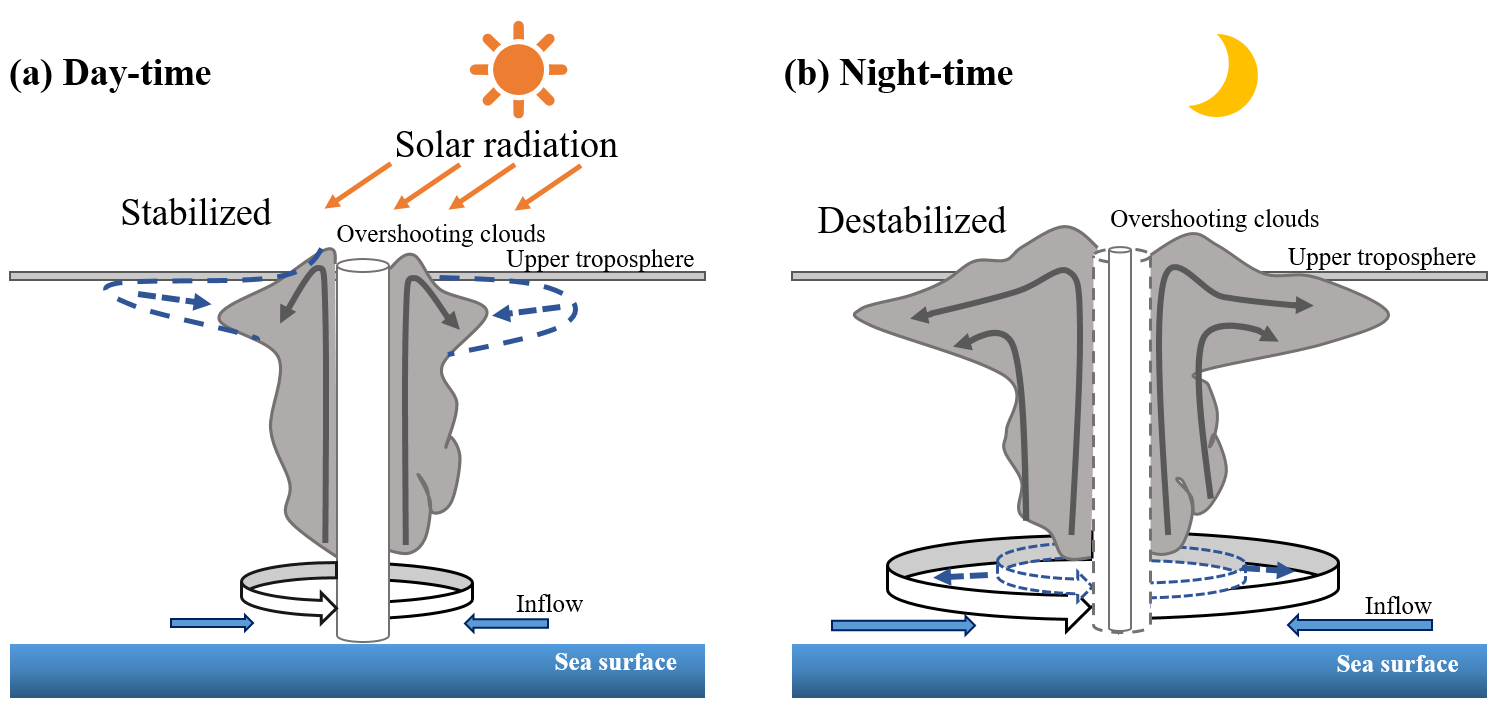
Diurnal Variations in Tropical Cyclones
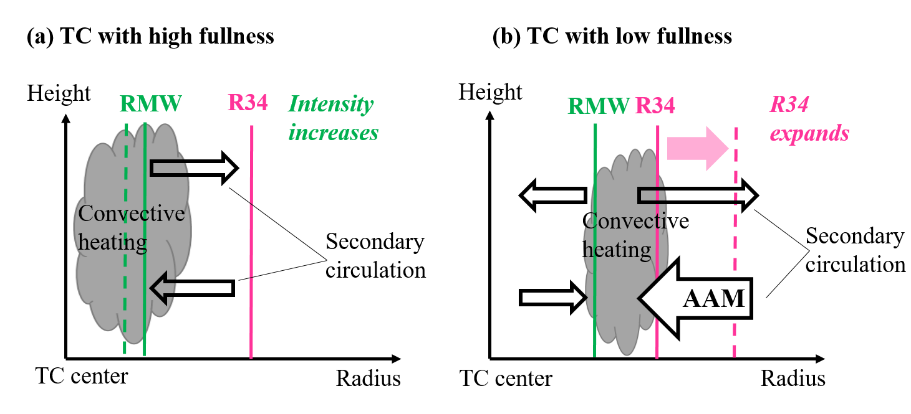
Tropical Cyclone Outer Region Size Growth